

Policy
At the beginning of 21st Century, Ukraine developed its legislation in the field of electronic documents and electronic digital signatures. The State regulation in this sphere is aimed at protecting the rights and interests of the parties involved in the electronic document flow.
Ukraine has also recently improved its legislation on the payment systems, emission and usage of electronic payment instruments and electronic money.
However, there is no basic statute on electronic commerce in Ukraine. The Draft Law "On the Electronic Commerce" is intended to fill in existing gaps. It was included to the agenda of Ukrainian Parliament on Dec. 11, 2014 and its enactment is expected.
The main acts governing electronic commerce are as follows:
The Laws of Ukraine:
• On the Electronic Documents and Electronic Documents Flow;
• On the Electronic Digital Signature;
• On Payment Systems and Transfer of Funds in Ukraine.
The Regulation of the NBU:
• On Electronic Money in Ukraine;
• On the Emission of Electronic Payment Instruments.
Regulator
|
NBU |
• Issues the banking licenses and the licenses for the transfer of funds without opening of accounts; • Provides oversight of the payment systems; • Maintains the register of payment systems; • Approves the guidelines for using electronic money. |
|
Ministry of Justice of Ukraine |
Certifies keys for the centers on certification of keys (the central certification authority). |
|
State Administration of Special Communication and Protection of Information |
Provides oversight of the electronic digital signature. |
Electronic Documents and Electronic Signature
Electronic document is defined as a document containing information in the form of electronic data. The electronic signature is intended to identify the author of an electronic document. The attachment of an electronic signature means that the electronic document is completed. In any case, electronic document can be turned into a visual form.
It is not acceptable to deny legal validity of an electronic document on the sole basis that it is in electronic form. The same statement is true when an electronic document is used as evidence. Nevertheless, electronic document cannot be used as the original of the document confirming the right for inheritance and in some other specific cases.
An electronic digital signature ensures activity of individuals and legal entities involving electronic documents. Thus, the main purpose of an electronic digital signature is to confirm integrity of an electronic document and to identify its signatory. In general, the digital signature refers to the data in electronic form obtained by cryptographic transformation of a set of electronic data.
In order to attach an electronic digital signature, the signatory should have a personal electronic key.

The legal status of an electronic digital signature is equal to the status of a personal signature provided that some technical requirements are satisfied. It is not acceptable to deny a legal validity of an electronic digital signature on the sole basis that it exists in electronic form.
Electronic Payment Systems
The transfer of funds in Ukraine can be performed through payment systems which are maintained and managed by special legal entities - payment organizations. These payment organizations can be residents or non-residents.
In general, the structure of the payment system is the following: payment organization (bank or non-bank financial institution), participants of payment system and relations between such payment organization and participants.
The main function of participants is the direct provision of services on the transfer of funds by means of a payment system. Such services are rendered on the basis of respective agreements between the participant and the payment organization. According to this agreement, inter alia, the participant is obliged to pay a certain amount of money (in UAH) to the payment organization for its services.
The following entities can obtain the status of the participant:

Two types of payment systems can exist in Ukraine: domestic and international.
Domestic payment systems ensure the transfer of funds exclusively within the territory of Ukraine. Such payment systems can be managed only by resident payment organizations.
International payment systems operate within the territory of two and more states. They can be managed either by resident or non-resident payment organizations.
It is worth mentioning that payment organizations and participants are entitled to carry out respective activity only after their inclusion into the register of payment systems (see "Regulator").
Electronic Payment Instruments
According to current Ukrainian legislation, electronic payment instruments (credit/payment cards) allow their holders to initiate transfer of funds. Electronic payment instruments can exist in any form on any data storage device which allows the storing of information.
Only the banks having executed agreement with a respective payment system are entitled to issue electronic payment instruments. Any individual or legal entity has the right to use electronic payment instruments. The agreements between banks and users of electronic payment instruments should be executed in written form in Ukrainian (upon agreement of the parties another language is possible).
In addition, the bank has the right to issue an electronic payment instrument in the form of a mobile payment instrument and to support operations with such an instrument. Mobile payment instruments can be implemented through mobile phone or another wireless device serviced by the telecommunication operator.
Electronic Money
Electronic money is considered as cost units which are kept in the electronic device and used as the means of payment. Only banks have the right to issue electronic money. After the issuance, they are purchased by users or commercial agents.
Users can be legal entities or individuals who can use electronic money as a mean of payment for the goods, works and services. In addition, individuals can transfer electronic money to other users-individuals. However, legal entities do not have the possibility to make such a transfer.
Commercial agents can perform one or several of the following functions:
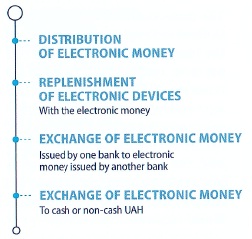
It is worth noting that the exchange of electronic money to cash or non-cash UAH can be performed only by banks and non-bank financial institutions which have the license of the NBU to transfer of funds without opening of accounts.
The bank which is intending to issue electronic money should approve with the NBU the guidelines for using electronic money.
According to current legislation, electronic money can be denominated only in UAH.
Contemplated Reforms
The Draft Law "On the Electronic Commerce" refers to the execution of agreements in electronic form. In particular, this Law governs electronic sale and purchase of goods, works and services, activity of Internet-shops, distribution of commercial information, monetary settlements, protection of personal data, storage of electronic documents etc.



